Ludo rules: how to play from start to finish
By the SketchPlay team · Updated
Ludo rules are simple to learn but have a few details families argue about: when you can leave base, which squares are safe, whether a capture earns another roll and what happens after three sixes. This guide settles all of them and shows how SketchPlay plays.
What do you need to play Ludo?
Ludo is a race game for two to four players. The board is a cross with a coloured corner base for each player, a track of squares running round the outside, and a coloured home column leading from each side to the centre. Each player has four tokens of their colour and the players share one six-sided die.
It comes from the Indian game Pachisi, which is centuries old, and today it is one of the most played board games in the world, on a table and on phones.
What is the goal of Ludo?
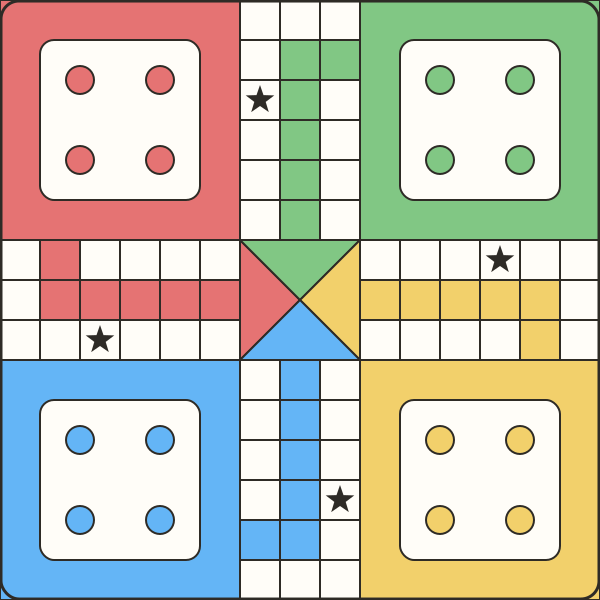
Each player tries to move all four tokens from their base, once round the board and up their home column to the centre. The first player with all four tokens home wins. The others can play on for second, third and fourth place.
Do you need a six to start in Ludo?
All tokens begin in base. A token can only leave base on a roll of 6, which places it on your start square, the coloured square just outside your base. Until you roll a 6, you can't move at all, which is why the first few turns can feel slow.
Rolling a 6 also gives you another roll. So a 6 usually means bringing a token out and then moving it with the bonus roll, or moving a token already out by six squares and rolling again.
How do you move your tokens?
On your turn, roll the die and move one of your tokens forward by exactly that number of squares. Tokens travel clockwise round the outer track. You choose which token to move, and good Ludo is mostly about that choice.
If none of your tokens can move by the number rolled, your turn simply passes. You can't split a roll between two tokens.
Three sixes in a row
Rolling a 6 gives another roll, but a third 6 in a row ends your turn. This stops a lucky streak from running forever.
How does capturing work in Ludo?
If your token lands exactly on a square occupied by an opponent's token, you capture it: their token goes back to its base and must wait for another 6 to come out again. A capture also earns you another roll, so it's both an attack and a tempo gain.
Captures happen only by landing exactly on the square. Passing over a token does nothing.
Which squares are safe in Ludo?
Some squares are safe, and a token standing on them can't be captured. In standard Ludo the safe squares are each player's start square and the star squares marked round the board. Your home column is safe too, because only your own tokens can enter it.
Safe squares are where you park a token when a rival is close behind it. Learning where the stars are is the quickest way to stop losing tokens.
How do you get your tokens home?
When a token has gone almost all the way round, it turns off the outer track into your coloured home column and runs up to the centre. You need the exact number to reach the centre: if the roll is bigger than the squares left, that token can't move with it.
Bringing a token home earns another roll, like a 6 or a capture.
What house rules do families play in Ludo?
Common Ludo house rules let a 1 as well as a 6 release a token, turn two same-colour tokens into a block nobody can pass, require a capture before entering the home column, or remove the extra roll for a capture. SketchPlay plays the standard rules described above, without these variants.
Ludo has more family variants than almost any other game. You may have played with some of these:
- A 1 as well as a 6 lets a token leave base.
- Two tokens of the same colour on one square form a block that nobody can pass.
- A player must capture at least one token before any of their tokens may enter the home column.
- No extra roll for a capture or for reaching home.
How does SketchPlay play Ludo?
SketchPlay uses the classic rules in this guide: a 6 to leave base, clockwise movement, captures send tokens back to base, star and start squares are safe, a 6, a capture or reaching home earns another roll, three sixes in a row lose the turn, and you need the exact number to reach the centre.
Play online with two to four friends, each on their own phone or computer with voice chat, or play the computer or friends on one screen in the solo version.
How do you win at Ludo?
To win at Ludo, get two or more tokens out early, keep tokens out of reach of rivals unless they sit on safe squares, use sixes to release new tokens or rescue one in danger, and capture when it is cheap rather than breaking up a safe position to attack.
- Get more than one token out early, so a single bad roll doesn't leave you stuck.
- Don't leave a token sitting six or fewer squares in front of a rival unless it's on a safe square.
- Use 6s to bring new tokens out when your other tokens are safe; use them to escape when a token is in danger.
- Chase captures when they are cheap, but don't break up a safe position just to attack.
Ludo FAQ
- Do you need a 6 to start in Ludo?
- Yes, in the classic rules a token can only leave base on a 6. Some families also allow a 1, but SketchPlay uses the 6.
- Which squares are safe in Ludo?
- Each player's start square and the star squares round the board. Your own home column is safe too.
- Do you get another turn after capturing?
- Yes. A capture earns another roll, just like rolling a 6 or bringing a token home.
- What happens after three 6s in a row?
- Your turn ends, so a streak of sixes can't go on forever.
- Do you need an exact roll to finish?
- Yes. A token reaches the centre only with the exact number; a bigger roll can't be used for that token.
Handy tools
- Dice roller: Roll one to six dice. See every die and the total.
- Coin flip: Heads or tails, with a running count.
Related guides
- Snakes and ladders rules for every player: Ladders, snakes, sixes and the exact roll to 100.
- Carrom rules and scoring, explained: Break, queen and cover, fouls, dues and points.
- Colour match card game rules and scoring: Action cards, Wilds, the challenge and scoring.