Hand cricket rules: how to play, step by step
By the SketchPlay team · Updated
These hand cricket rules cover everything you need to play the classroom favourite: the toss, how a ball works, how runs and outs are decided, overs, chasing a target and what happens on a tie. You can learn them in two minutes and play your first match straight away.
What is hand cricket?
Hand cricket is cricket played with nothing but your hands. One player bats, the other bowls, and every ball is a quick showdown: both players show a number of fingers at the same moment. The numbers decide whether the batter scores runs or is out.
It started in school corridors and on long bus rides across South Asia, and it has stayed popular because it needs no bat, no ball and no space. All you need is a friend and a sense of timing. It is also a surprisingly good game of nerve, because you are always guessing what the other player will show next.
What are the rules of hand cricket?
Hand cricket is played by two people with one hand each. After a toss, one bats and one bowls. On every ball both show a number from 1 to 6 together: different numbers score the batter's number as runs, the same number is out. Then the other player chases the total.
- Toss a coin. The winner chooses to bat or bowl first.
- On every ball, both players show a number from 1 to 6 at the same time.
- If the numbers are different, the batter scores the number they showed.
- If the numbers are the same, the batter is out.
- When the first innings ends, the other player bats and chases the score.
- The chaser wins as soon as they pass the target. If they don't, the first batter wins. Equal scores are a tie.
How do you show numbers with your fingers?
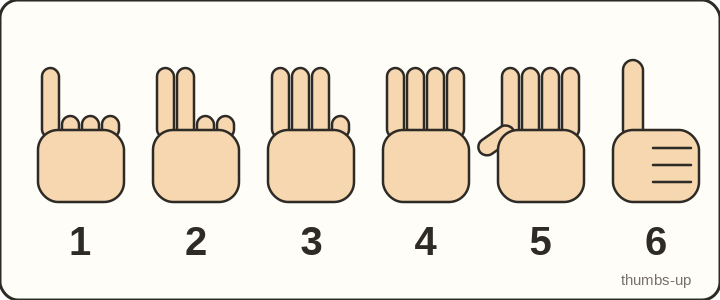
One to five are simply that many fingers. Six is usually a thumbs-up or a closed fist, depending on where you learned the game; agree on it before you start. Show on a count, such as "one, two, three, show", so nobody can wait and react to the other hand.
Online the count is built in: both players pick a number in secret and the picks are revealed together, so there is no way to peek or show late.
How do batting and bowling work?
The batter wants to show a different number from the bowler, and ideally a big one, because the batter scores exactly what they show. A six is worth six runs, a one is worth one. The bowler wants to match the batter's number, because a match takes the wicket.
This is what makes the game interesting. Showing 6 every ball scores fast, but a bowler who notices will start showing 6 too. Mixing big and small numbers keeps the bowler guessing, and the bowler in turn tries to read your habits.
When is the batter out?
Only when both players show the same number. There are no catches, no run-outs and no LBW: a matching number is the one way to lose a wicket.
Do the bowler's numbers matter?
Only to take the wicket. The bowler never scores runs while bowling; their number is simply a guess at what the batter will show.
How many overs and wickets are there?
A playground game often has no overs at all: you bat until you are out. That can make one innings last a very long time, so most players add overs. An over is six balls, just as in real cricket.
On SketchPlay each innings has one wicket and a set number of overs. The innings ends when the batter is out or when the overs run out, whichever comes first. Public matches are two overs a side; in a private room the host can choose 1, 2, 5 or 10 overs, or any number up to 20.
How do you chase a target?
When the first innings ends, its score plus one becomes the target. The second batter wins the moment they pass the first score, even in the middle of an over. If they are out first, or the overs run out before they get there, the first batter wins.
The chase changes the mood of the game. Needing four runs from the last ball is very different from batting freely in the first innings, and good bowlers use that pressure: a chaser who needs a six is likely to show a six.
What happens on a tie?
If both innings finish level, the match is a tie. Some groups simply share the win; others play a super over. In a super over each player bats for one over with one wicket, and the higher score wins. If that is level too, the match stays tied.
On SketchPlay the super over is an option the host can turn on before the match. With it off, equal scores end as a tie.
What house rules do people play in hand cricket?
The most common house rules in hand cricket add a dot ball for a closed fist, limit or widen the numbers you may show, give each side two or three wickets, or ban showing the same number three balls in a row. Agree on them before the toss so nobody argues mid-innings.
Hand cricket changes from school to school. These variants are the ones you will meet most often:
- Zero or a closed fist as a dot ball that scores nothing.
- Numbers only up to 5, or up to 10 using both hands, which makes outs rarer and scores bigger.
- More than one wicket per innings, often two or three for longer games.
- A rule that the same number may not be shown three balls in a row.
How does SketchPlay play hand cricket?
SketchPlay uses the classic rules above: numbers 1 to 6, a coin toss with the winner choosing to bat or bowl, one wicket per innings and six balls an over. Each ball has a short timer (5, 10 or 15 seconds, chosen by the host); if a player doesn't pick in time, a number is picked for them at random.
You can play a random opponent with quick match, or create a private room, share the code and talk over voice chat while you play.
How do you win at hand cricket?
Winning at hand cricket is about being hard to read and reading your opponent. Avoid fixed patterns, watch the last few numbers they showed, and as bowler aim for the batter's favourite number. In a tight chase, think about what the batter needs: big numbers come out when only a few balls remain.
- Avoid a fixed pattern. Players who always follow a 6 with a 4, for example, are easy to read.
- Watch your opponent's last few numbers. Most people avoid repeating the same number, so a number they just showed is a slightly safer pick for you as batter.
- As bowler, match the batter's favourite. Many batters return to 6 or 4 when they want quick runs.
- In a close chase, think about what the batter needs. If four runs win the game, expect a 4, 5 or 6.
Hand Cricket FAQ
- How many players can play hand cricket?
- Two: one batter and one bowler, who swap for the second innings. Groups sometimes play in teams, taking turns to bat.
- What does a closed fist mean in hand cricket?
- It depends on the group. Many players use a fist or a thumbs-up for 6, and some use a fist for a dot ball. Agree before you start; online you simply tap a number.
- Can the bowler score runs?
- No. Only the batter scores. The bowler's number only matters if it matches the batter's, which takes the wicket.
- How long is a game of hand cricket?
- A two-over match takes about three minutes. Longer matches of 5 or 10 overs take ten to twenty minutes.
- What happens if the scores are level?
- The match is a tie, unless you play a super over: one more over each, with the higher score winning.
Handy tools
- Coin flip: Heads or tails, with a running count.
- Score keeper: Running scores for up to eight players.
Related guides
- Stone paper scissors tricks to win more rounds: Patterns people fall into and how to beat them.
- Ludo rules: how to play from start to finish: Sixes, captures, safe squares and getting home.
- Darts 501 rules: scoring, double out and busts: Scoring, double out, busts and checkouts.